How I'm Combining a Todo MCP App With 6 Productivity Books to Build a High-Performance Execution System for Solo Founders
Most productivity advice starts with the same assumption:
You have too much to do, so you need to become better at doing more.
I’m starting to believe that’s the wrong problem.
For builders and solo founders, the real challenge is rarely a lack of things to do. It is the opposite.
There are always too many ideas, too many features, too many tools to explore, too many things that look useful, and too many directions that could work.
The danger is not laziness.
The danger is becoming extremely productive at work that does not matter.
So I’ve been building a different system.
I call it my Personal Execution OS.
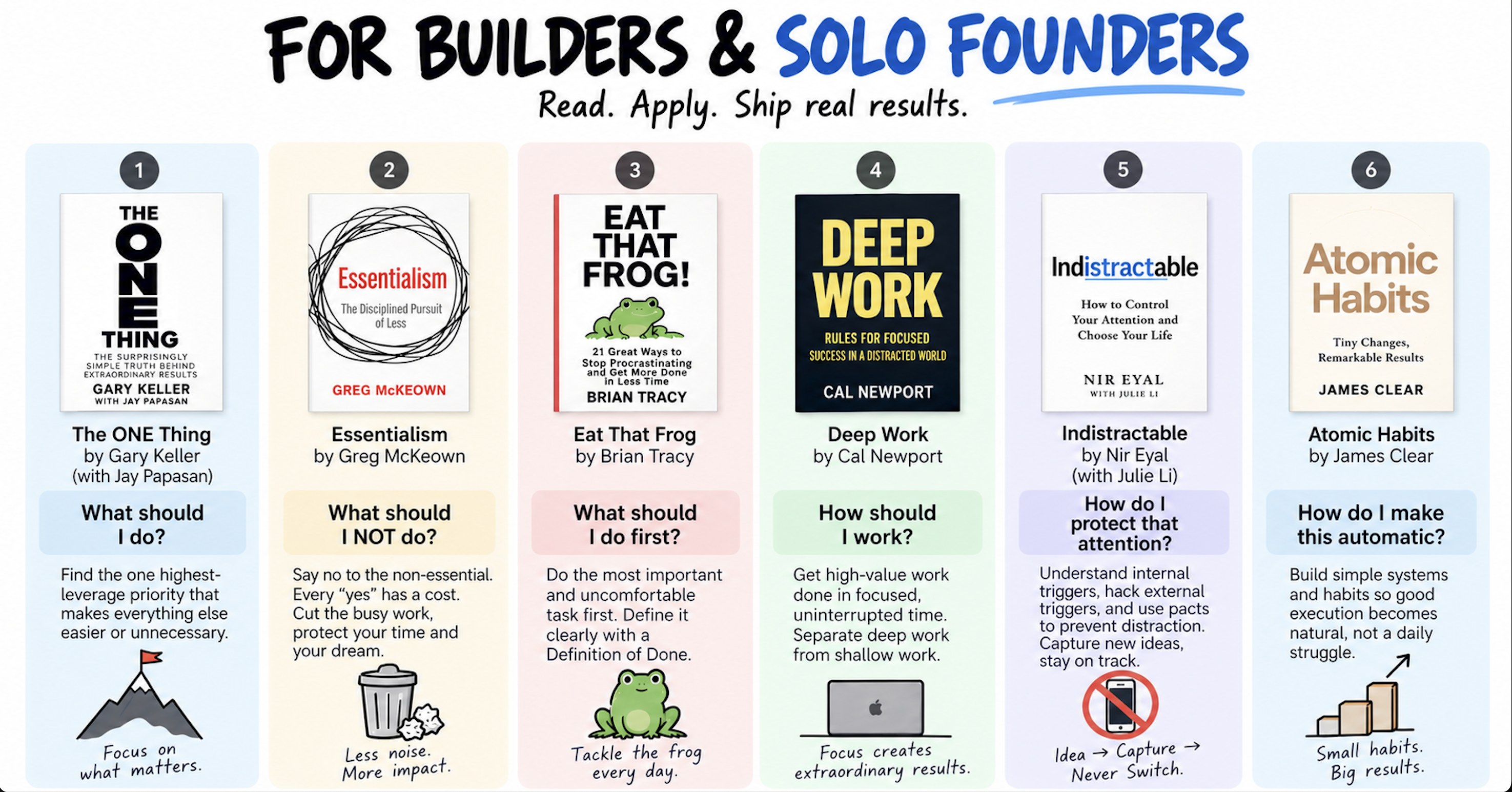
It combines six books that shaped how I think about productivity:
The ONE Thing - Gary Keller & Jay Papasan
Essentialism - Greg McKeown
Eat That Frog! - Brian Tracy
Deep Work - Cal Newport
Indistractable - Nir Eyal
Atomic Habits - James Clear
And then I connect those ideas to a Todo app through MCP + AI.
The result is not another task-management system.
It is a system designed to turn:
ambition → focus → execution → shipping → market feedback → revenue.
That distinction matters.
My goal is not to complete more tasks.
My goal is to create more meaningful outcomes with less wasted effort.
The problem with traditional productivity
Imagine this was your day:
fixed five bugs
answered 20 messages
researched three AI tools
attended two meetings
redesigned a component
read several articles
cleaned your backlog
completed 14 tasks
You could finish the day feeling productive.
But then ask:
What actually changed?
Did something ship?
Did users see it?
Did someone sign up?
Did you talk to a customer?
Did anyone pay?
Did the business move forward?
This is why I now think of work in four levels:
| Level | Work | Value |
|---|---|---|
| L0 | Activity | Research, reading, meetings |
| L1 | Output | Code written, article finished |
| L2 | Shipped | Production, published, sent to customers |
| L3 | Outcome | Leads, users, customers, revenue |
The goal is not to eliminate L0 or L1.
They are often necessary.
But I want more of my time to eventually reach L2 and L3.
That changes how I evaluate a productive week.
Instead of asking:
How many tasks did I finish?
I ask:
What outcome did those tasks create?
The six books become one execution loop
I don’t treat these six books as six separate productivity systems.
I treat them as six layers of the same system.
THE ONE THING
What matters most?
        ↓

ESSENTIALISM
What should I remove?
        ↓

EAT THAT FROG
What must happen first?
        ↓

DEEP WORK
How do I execute it?
        ↓

INDISTRACTABLE
How do I protect that execution?
        ↓

ATOMIC HABITS
How do I repeat it automatically?
        ↓

SHIP
        ↓

MEASURE
        ↓

LEARN
        ↓

NEXT ITERATION
This is the core of my Personal Execution OS.
The important part is that each book solves a different bottleneck.
1. The ONE Thing: decide what actually matters
The first problem is not execution.
It is selection.
A solo founder can easily have ten things that all appear important:
improve onboarding
publish content
fix technical debt
redesign pricing
build an AI feature
talk to customers
research competitors
improve SEO
automate support
launch another product
The ONE Thing forces a harder question:
Which action has the highest leverage right now?
I try to maintain only three levels:
Quarterly ONE Thing
        ↓
Weekly ONE Thing
        ↓
Daily ONE Thing
For example:
Quarter:
Get the first 20 paying customers.

Week:
Launch the paid offer.

Today:
Publish pricing and checkout.
The rule is simple:
The Daily ONE Thing must support the Weekly ONE Thing.
The Weekly ONE Thing must support the Quarterly ONE Thing.
If I cannot explain that connection, the task deserves to be challenged.
This is where AI becomes useful.
Instead of simply accepting everything I add to my Todo app, I want the AI to ask:
“How does this help your current ONE Thing?”
That is much more valuable than another assistant that helps me do everything faster.
2. Essentialism: ambition requires subtraction
Being selective is not the opposite of being ambitious.
I think the more ambitious the goal, the more aggressively you have to protect your attention.
Every new commitment consumes:
time
attention
energy
maintenance
future decision-making capacity
So alongside my task list, I need a Kill List.
During a weekly review, AI can inspect my Todo system and classify work into:
DO NOW
DELEGATE / AI
DEFER
DELETE
I especially want it to challenge:
random new projects
premature optimization
overengineering
research without a decision
features without customer signals
If I add:
“Research this new AI framework”
the right response is not immediately:
“Here are 50 resources.”
The better question is:
“How does this help this week’s ONE Thing?”
If there is no convincing answer:
move it to Someday.
That is how I use Essentialism to fight productive procrastination.
3. Eat That Frog: turn priority into action
Knowing what matters is not enough.
Important work is often the easiest work to postpone.
That is why I like Brian Tracy’s idea of the “frog”:
Do the most important, uncomfortable task first.
But I add one requirement.
A Frog must have a Definition of Done.
Bad:
Work on marketing.
Better:
Publish landing page with CTA and working payment.
Bad:
Improve product.
Better:
Ship onboarding v2 to production and test the complete signup flow.
The Todo app stores the task.
AI helps turn it into an executable outcome.
At the end of each day, my AI can inspect:
the Weekly ONE Thing
unfinished tasks
deadlines
revenue opportunities
and propose tomorrow’s Frog.
This eliminates an expensive morning decision:
“What should I work on today?”
That decision has already been made.
4. Deep Work: protect enough time to finish important things
A beautifully prioritized task list is useless if the day is destroyed by context switching.
So the Frog needs a calendar block.
For example:
08:00–10:30

DEEP WORK

Outcome:
Pricing + payment LIVE

Allowed:
IDE
Docs
AI
Terminal

Blocked:
X
News
Email
Analytics
Random research
I don’t need eight hours of Deep Work every day.
For many builders, one serious uninterrupted block can create more meaningful progress than an entire day of fragmented activity.
That is why the daily goal is not:
Stay busy all day.
It is:
Win the most important block of the day.
5. Indistractable: the biggest distraction may look like work
Social media is an obvious distraction.
But for builders, I think there is a more dangerous type:
productive distraction.
You are building Feature A.
Then:
Feature A
↓
discover new library
↓
GitHub
↓
interesting architecture
↓
new product idea
↓
buy domain
↓
prototype
Three hours later, you have been “working” the entire time.
But Feature A still hasn’t shipped.
My rule is:
NEW IDEA → CAPTURE → NEVER SWITCH
This is where the Todo MCP integration becomes powerful.
While I am working, I can tell the AI:
“Save this idea.”
The agent creates:
IDEAS
→ Explore XYZ
And that is the end of the interaction.
No research.
No new active project.
No context switch.
The idea can only be promoted during Weekly Review.
This gives me an important psychological benefit:
I don’t have to fear forgetting a good idea.
But I also don’t have to obey every idea immediately.
6. Atomic Habits: make execution require less willpower
The final layer is repetition.
I don’t want a productivity system that works only when I feel motivated.
So instead of tracking 20 habits, I prefer a few keystone habits:
□ Plan tomorrow
□ Frog before shallow work
□ ≥2h Deep Work
□ Daily shutdown
□ Ship something
Then create a predictable sequence:
Wake
↓
Coffee
↓
Desk
↓
Do Not Disturb
↓
Open today's ONE Thing
↓
Start Frog
↓
Deep Work
The goal is to reduce decisions.
Good execution should gradually become the default state rather than something I have to negotiate with myself every morning.
Where the Todo MCP app changes everything
Books are good at teaching principles.
Todo apps are good at storing execution.
AI is good at reviewing patterns, asking questions and connecting data.
MCP connects those layers.
That means my AI does not need to depend on what I remember to tell it.
It can inspect the actual execution system:
projects
tasks
deadlines
completed tasks
notes
priorities
And, where permitted:
create task
move task
set deadline
change priority
complete task
add review notes
But I apply one strict governance rule:
AI can organize execution, but it cannot freely create new active projects.
New ideas go to:
IDEAS
Only a deliberate review can promote them.
Otherwise an AI assistant can create the exact problem it is supposed to solve: more tasks, more ideas and more complexity.
The Morning AI Review
The first useful MCP workflow is very simple.
Every morning, AI reads the task system and returns something like:
TODAY

🎯 Weekly ONE Thing
Launch paid offer

🐸 Frog
Pricing + payment LIVE

🧠 Deep Work
08:00–10:30

⚠️ Avoid today
- redesign
- new product ideas
- analytics before noon

💰 Money Move
Send offer to 5 qualified prospects
The most important addition here is the last one:
One Money Move Every Day
This is something I add on top of the books.
Because builders have a specific failure mode:
build
↓
build
↓
build
↓
build
↓
nobody buys
So every day I want at least one action that touches the market:
talk to a customer
send an offer
ask for payment
follow up
publish a CTA
improve checkout
contact leads
distribute content
upsell
run a user interview
My daily system therefore becomes:
ONE Thing + ONE Money Move.
One keeps the product moving.
The other keeps the product connected to reality.
The Evening AI Review
At the end of the day, the AI does not ask me to write a journal essay.
It asks seven short questions:
1. Frog shipped?
YES / NO

2. Deep Work?
___ minutes

3. Money Move?
YES / NO

4. What shipped?

5. Outcome?
lead / signup / sale / revenue

6. Biggest distraction?

7. Tomorrow's Frog?
Then it updates the Todo system.
This creates a feedback loop without adding much administrative overhead.
I don’t want a productivity score based on task count
Completing 27 low-value tasks should not beat completing three important ones.
So my daily Execution Score is intentionally small:
ONE Thing progress      0–2
Frog completed          0–2
Deep Work ≥2h           0–2
Something shipped       0–2
Money Move              0–2

Total                   /10
You can finish three tasks and score 10/10.
You can finish 27 tasks and score 4/10.
That is exactly the point.
Weekly Review: where AI becomes a real coach
This is probably the most valuable part of the system.
Every week, the agent can review actual evidence:
Frogs completed
Deep Work hours
Things shipped
Money Moves
Leads
Users
Customers
Revenue
Then it evaluates the week through the six books.
The ONE Thing
What produced the most leverage?
Essentialism
What did I do that should never have been done?
Eat That Frog
Which important task did I keep delaying?
Deep Work
How much high-value focused work actually happened?
Indistractable
What was my biggest distraction or context-switching pattern?
Atomic Habits
Which behavior became easier through systems, and which still depended on willpower?
This turns books from passive knowledge into an operating framework.
Then I ask the most uncomfortable question
Where is the money?
For a commercial product, I want the AI to look at the whole funnel:
BUILD
↓
SHIP
↓
TRAFFIC
↓
LEAD
↓
CUSTOMER
↓
REVENUE
Then identify the bottleneck.
For example:
Shipping is high, traffic is low
Stop building.
Work on distribution.
Traffic is high, signup is low
Work on positioning or landing page conversion.
Signup is high, payment is low
Work on offer, pricing or trust.
Customers are growing, retention is poor
Return to the product.
The productivity system should respond to the business bottleneck.
Otherwise AI is simply giving generic productivity advice.
Every review must end with a decision
One thing I do not want from AI is a beautiful two-page analysis that changes nothing.
A review should end with:
KEEP

STOP

START

DOUBLE DOWN

KILL

NEXT WEEK'S ONE THING

MONDAY'S FROG
For example:
KEEP
Deep Work before 11

STOP
Checking analytics repeatedly

START
5 customer outreaches/day

DOUBLE DOWN
Content → landing page funnel

KILL
Side project X

NEXT WEEK ONE THING
Get 3 paying customers

MONDAY FROG
Send the offer to first 10 qualified leads
Then:
Review → Decision → Todo app.
If a review does not change the next week’s execution, it is mostly entertainment.
Measuring founder leverage
At the monthly level, I want to move beyond ordinary productivity metrics.
For example:
TIME
Deep Work: 61h

OUTPUT
Shipped: 17

MARKET
Traffic
Leads

BUSINESS
Customers
Revenue
MRR
Then I can start exploring metrics such as:
Revenue per Deep Work Hour
$2,000 revenue
÷
50 Deep Work hours

= $40 / Deep Work Hour
The absolute number is not very important in the beginning.
The trend is.
Is my leverage increasing?
Am I becoming better at turning focused effort into business results?
Another metric I like is:
Ship → Money Ratio
If I shipped 20 things but only two contributed to revenue:
2 / 20 = 10%
Now AI has another question:
What was different about those two?
Then:
double down.
Over time, the business starts learning what kinds of work deserve more attention.
My AI is not supposed to make me busier
This might be the most important design principle.
I do not want an AI assistant whose job is:
Help me execute every idea.
I want one whose job is:
Help me determine which ideas deserve execution.
My ideal AI coach has a very clear mandate:
Do not maximize completed tasks.
Maximize meaningful shipped outcomes and progress toward revenue.
It should challenge me when:
I start unnecessary projects
I overengineer
I research without a decision
I build without customer evidence
I optimize vanity metrics
my daily work no longer supports the Weekly ONE Thing
And each day it should identify only:
ONE Thing
Frog
Deep Work block
Money Move
Things not to do
That is a very different relationship with AI than simply asking:
“What else can I automate?”
The complete Solo Founder Execution Loop
The whole system looks something like this:
GOAL
 ↓
QUARTERLY OUTCOME
 ↓
AI WEEKLY REVIEW
 ↓
ONE THING
 ↓
ESSENTIALISM
 ↓
KEEP / KILL
 ↓
TODO APP
 ↓
TOMORROW'S FROG
 ↓
DEEP WORK
 ↓
SHIP
 ↓
MONEY MOVE
 ↓
RESULT
 ↓
DAILY AI REVIEW
 ↓
DATA
 ↓
WEEKLY AI REVIEW
 ↓
KEEP / STOP / START
KILL / DOUBLE DOWN
 ↓
NEXT ONE THING
And when distraction or a new idea appears:
New idea
↓
Capture with MCP
↓
IDEAS
↓
Return to current work
Not:
New idea
↓
New project
↓
New repo
↓
New domain
↓
New backlog
↓
Nothing ships
The system deliberately protects me from myself.
Productivity is not the goal
The final rule of my system is:
Never end a week with only output metrics.
This is not enough:
25 hours coding
7 articles
4 features shipped
I need to continue:
7 posts
↓
18K impressions
↓
420 visits
↓
37 signups
↓
8 qualified leads
↓
3 customers
↓
$297
That is when productivity finally connects to reality.
Do less does not mean dream smaller
I think this distinction is especially important for ambitious people.
“Do less” can sound like:
lower your expectations
slow down
accept smaller goals
become less ambitious
That is not how I see it.
For me:
The bigger the dream, the less attention I can afford to waste.
I still want to build.
I still want to ship.
I still want to experiment.
I still want to create products, grow businesses and pursue difficult goals.
But ambition without selection becomes chaos.
And productivity without outcomes becomes sophisticated procrastination.
The six books give me the philosophy.
The Todo app gives me an execution layer.
MCP gives AI access to the real state of the system.
And AI gives me something traditional task managers cannot:
continuous reflection, challenge and feedback.
Together, they create the loop I want to operate by:
Time → Focus → Ship → Market Feedback → Revenue → Learn → Double Down.
For me, that is what modern productivity should look like for builders and solo founders.
Not doing everything.
Not being busy all day.
Not collecting productivity tools.
But building a system that helps you repeatedly answer:
What matters most now — and can I turn it into a real result?
Thank you for reading here!


